
Shared Spaces: 3 Steps to a Healthier Clean


Whether it’s a bustling office, a crowded restroom, or a communal eating area, maintaining a healthy environment is crucial. Although we’ve made it through another respiratory illness and cold season, germs continue to spread, and cleanliness remains a top concern in shared spaces. One thing that makes facility occupants the most uncomfortable in shared spaces is the risk of picking up illnesses1. Not only that, but higher productivity and better outcomes for employees and students are a result of clean spaces2,3. Fortunately, there are simple solutions for cleaning and disinfecting that can help. This blog outlines a straightforward three-step approach to maintain healthier shared spaces.
A Healthy Shared Space Can Be as Easy as 1-2-3
The following points illustrate 3 simple steps to approach cleaning and disinfection of commonly shared spaces across all facilities.
-
Identify Key Challenges in Shared Spaces
- Restrooms:
- Over 50% of facility cleaning managers cite restrooms as the most challenging space to keep clean4.
- Top concerns include germs, urine odors, stains and mold.
- Workspaces:
- The number of high-touch surfaces enables germs to spread quickly.
- The average worker's desk has more than 20,000 germs per square inch5, and school classrooms contain upwards of 34,000 germs per square inch6.
- Eating Areas:
- 75% of break room sink faucet handles, 48% of microwave door handles, and 26% of refrigerator door handles in break rooms were found to be hot spots for germs7.
- Eating areas tend to accumulate grease and grime and get dirty quickly.
- Restrooms:
-
Determine the Type of Cleaning Task
-
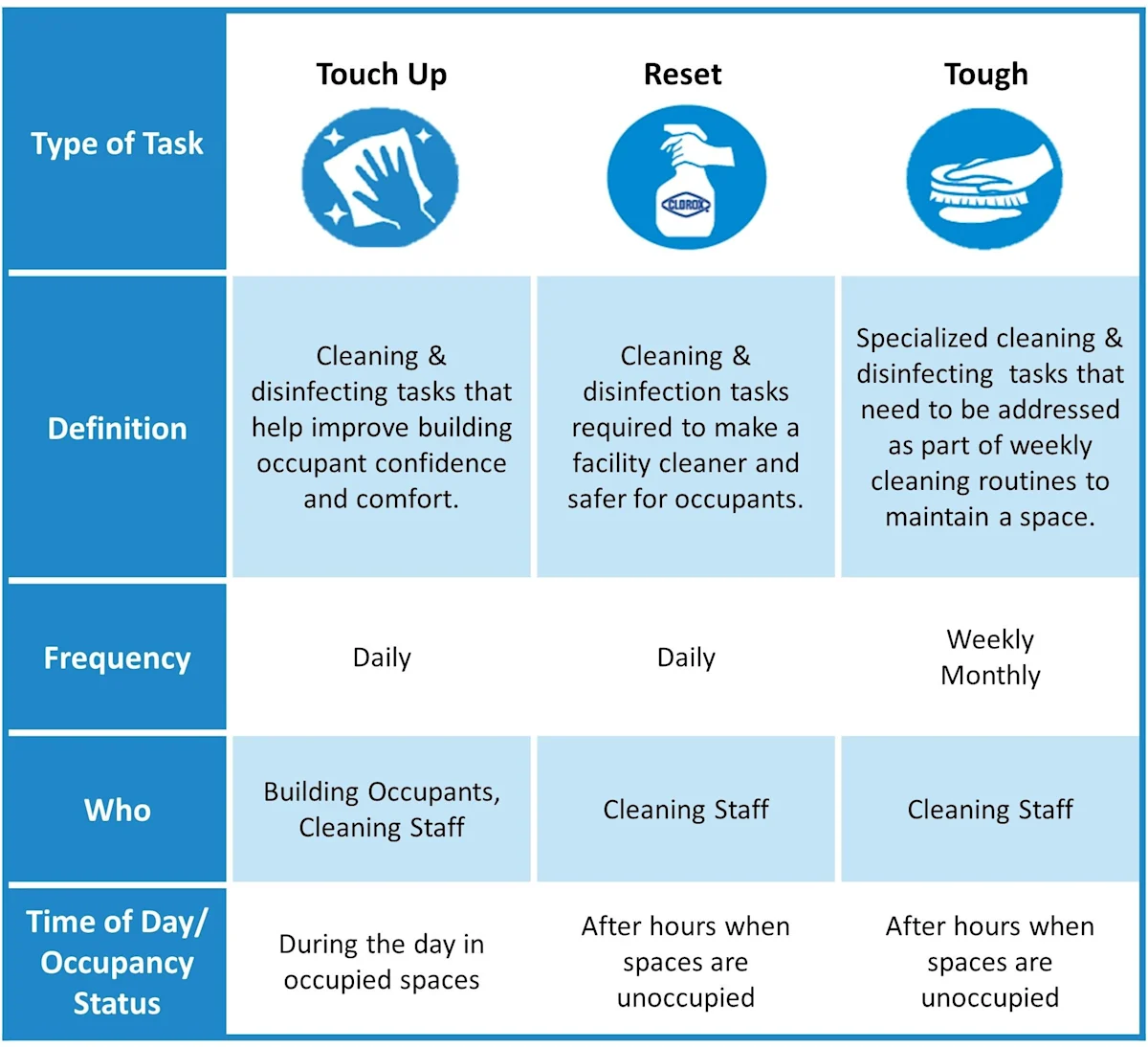
Cleaning tasks should be based on the specific space and its usage patterns. There is not a “one-size-fits-all” approach. Cleaning tasks will vary by space, occupancy, and time-of-day. Tailor your cleaning approach accordingly and prioritize tasks that directly impact occupants’ health and well-being. Use the table below to understand the key types of cleaning tasks and how and when to use each.
-
-
Choose the Right Product for the Space & Task
- When selecting a cleaning and disinfecting product, remember that not all products are suitable for a specific task. The key here is selecting the right product that compliments the space and task. My previous blog, A Goldilocks Approach to Cleaning and Disinfection, highlights some of the different product types and their benefits. Here are some additional considerations when selecting a product:
- Disinfectant: If killing germs is your top priority, select a product that is EPA-registered to kill pathogens commonly found on surfaces and that has a contact time under 3 minutes.
- Ready-to-Use (RTU): Cleaning and disinfecting products that are ready-to-use are convenient and simple to use with no dilution required. They offer versatility across many surfaces and spaces and contribute to cleaning efficiency.
- Eco-conscious: Disinfectants with a third-party certification, like EPA Design for the Environment (DfE), are an excellent alternative to traditional products. These products are EPA-registered and are effective against multiple pathogens.
- When selecting a cleaning and disinfecting product, remember that not all products are suitable for a specific task. The key here is selecting the right product that compliments the space and task. My previous blog, A Goldilocks Approach to Cleaning and Disinfection, highlights some of the different product types and their benefits. Here are some additional considerations when selecting a product:
Putting It All Together
Let’s review these steps and what they may look like in a real-life cleaning scenario using an example of a workspace. A simple outline could look like this:
- Key Challenge – A recent report about an RSV outbreak in the community and increased employee absences has given rise to concern about the transmission of RSV on high-touch surfaces at work.
- Cleaning Task – Cleaning and disinfection as a touch up task should be performed by cleaning staff and occupants throughout the day on high-touch surfaces such as desks, door handles, and handrails.
- Product to Use – Select RTU disinfecting wipes for quick, easy disinfecting of high-touch surfaces.
For more information on product solutions that are efficient and effective in maintaining healthy shared spaces with confidence, reference our Shared Spaces Toolkit and A Smarter Way to Healthier Shared Spaces website. Remember, healthier shared spaces benefit everyone. Let’s prioritize cleanliness and well-being in our facilities, beginning with 1-2-3.
Share this article
About the Author
More from the Clorox Pro Blog
References
- CloroxPro. 2023 Clean Index Study. Data for this report was collected in Spring 2023 an online survey of a nationally representative U.S. General Population based on age, gender, region, race/ethnicity and income and cleaning industry professionals defined as business service contractors, facility managers in education, commercial buildings, and healthcare facilities.
- Annual Workplace Survey [Internet]. Staples.com. [cited 2024 Apr 15]. Available from: https://www.staples.com/sbd/cre/marketing/workplace-survey
- Clorox. New research shows children are more creative in a clean workspace [Internet]. PR Newswire. 2019 [cited 2024 Apr 15]. Available from: https://www.prnewswire.com/news-releases/new-research-shows-children-are-more-creative-in-a-clean-workspace-300905487.html
- Facility Cleaning Decisions Magazine. 2023 Facility Cleaning Management Study [Internet]. July 2023. [cited 2024 Apr 15]. Available from: https://www.cleanlink.com/resources/editorial/2023/FCDManagementSurvey2023Final3.pdf
- Germs in Your Firm [Internet]. www.printerland.co.uk. [cited 2024 Apr 15]. Available from: https://www.printerland.co.uk/germs-in-your-firm-E412.aspx
- NSF. Germiest Places at Schools [Internet]. [cited 2024 Apr 15]. Available from: https://www.nsf.org/blog/consumer/germiest-places-schools
- Kimberly-Clark. Where the Germs Are: New Study Finds Office Kitchens and Break Rooms are Crawling with Bacteria [Internet]. 2012. Available from: https://kimberlyclark.gcs-web.com/news-releases/news-release-details/where-germs-are-new-study-finds-office-kitchens-and-break-rooms